Reps is here. Built for the era where people and AI execute together. Read the announcement.


Article
The Missing Half of the Learning Loop

Bhakti Vithalani
Founder & CEO, Reps
July 2026
Founder & CEO, Reps
July 2026
Enterprise AI is remarkably good at scaling what already works. The harder problem is learning when it no longer does.
A teenager can learn to drive in ten hours. An AI needs millions of hours of demonstrations and then drives a million cars at once. So the obvious move is to combine them. Speed plus scale.
But what happens when the driving rules change? The teenager notices. The system needs to be retrained.
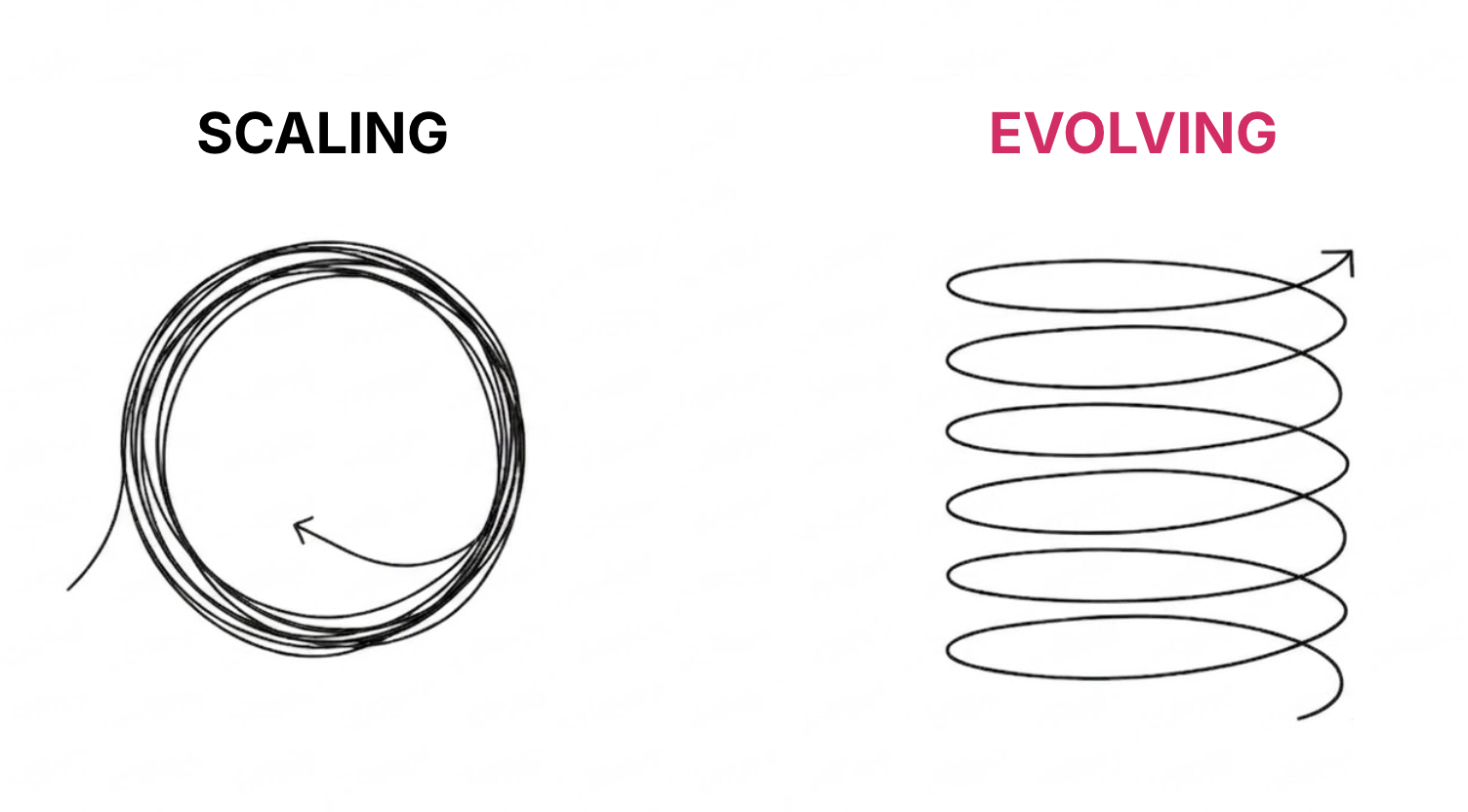
Driving rules change over decades. Work changes monthly, weekly, daily. Speed and scale don't adapt. They amplify.
Today's AI is very good at one thing. An engineer discovers a faster fix and AI makes it standard. A support agent finds a better way to close a case and the whole team has it by morning. "Generative AI at Work" quantified this: it tracked 5,172 call center agents as an AI assistant was rolled out.¹ Productivity rose 14% on average, but 34% for novices and near zero for the best agents. The AI didn't just answer questions. It captured the tacit knowledge that separated the top performers and routed it to everyone else. And the gains stuck. Durable learning, not a crutch that vanished when the tool did.
Scaling sounds like the complete solution until you notice the ceiling. You've become remarkably good at perfecting today's standard, and that's the trap. Scaling assumes today's playbook will still be tomorrow's playbook.
John Chambers, who led Cisco through five market transitions, likes to say, "Don't do the right thing for too long." Markets don't stand still. The pitch that worked last quarter stops working. A new AI disclosure regulation triggers fresh objections in every deal overnight. Your largest customers adopt an agentic version of your service — and their new bottleneck is your next market. An organization that only scales yesterday's playbook gets better and better at executing an increasingly outdated one. It institutionalizes irrelevance.
How do we keep learning when the work itself keeps changing?
Think about your best managers. They don't just teach. They listen. They stay close to the work. Every interaction updates their mental model of what’s changing. They notice who’s ready, which customer priorities are changing, what objections are emerging, and when the playbook is beginning to fail. Their value isn’t just in scaling what already works. It’s also in figuring out what’s next.
The bottleneck was never insight. It was attention. No leadership team could sit in thousands of conversations a week, across dozens of markets, hundreds of teams, thousands of channel partners, and separate signal from noise. So they didn't. They reviewed results after the fact, when it was already too late.
Reading the market as it moves was always the right idea. It was never possible — until now.
In one rollout, we asked field reps to describe their last win, and 400 responded within a week. No leadership team could make sense of 400 debriefs quickly enough to detect the pattern hidden inside them. The AI synthesized all 400 in under ten minutes. Eighty-one percent had independently encountered the same new objection. But they hadn't all handled it well because yesterday's playbook wasn't enough. The winning reps had converged on a handful of responses: a financing workaround and a low-risk pilot that let hesitant buyers say yes without betting the year on it. Those ideas didn't come from headquarters. They came from the field. The best field reps had adapted before headquarters did.
But wins are the easy case. The signals that matter most are the ones you're least likely to capture: losses, stalled deals, unexpected objections, and changing customer priorities. Few people volunteer a loss if it feels like a performance review. They will when the question changes from "Why did you lose?" to "What is the market trying to tell us?" Now you're no longer reviewing the past. You're reading the market for what's next.
Run that process again next month — on wins, losses, and stalls alike — and you'll get a different answer on what to scale, how to recover, and where to pivot. Because competitors reacted, customers learned, and yesterday's playbook has the shelf life of fruit.
The field doesn't just execute the playbook. It writes the next version.
Headquarters is no longer the Center of Excellence. It's the Curator of Excellence.
Almost every enterprise AI system today runs the loop in one direction: it captures what already works and pushes it out. The missing half runs the other way — upstream, from the field back to headquarters, surfacing what should work next.
That's the missing half of the learning loop.
Every other AI loop gets better at executing the objective. The upstream loop discovers when the objective itself has changed.
Neither direction is enough on its own. The best agents in the call center study barely improved because a downstream learning loop had nothing left to teach them. A field full of insight, meanwhile, creates no value unless it can be captured, tested, and spread. Put the two directions together and you get an engine: every cycle captures what worked, detects what changed, and rewrites the playbook. Every cycle raises the floor.
Human work isn't the edge case. It's how organizations keep discovering what's changing. AI remembers. People notice. AI recognizes patterns. People recognize change. AI scales what works. People create what’s next.
For most of business history, competitive advantage belonged to whoever knew the most, and what they knew stayed relevant for years. With AI, intelligence is becoming abundant. Competitive advantage now belongs to whoever adapts the fastest.
The first generation of enterprise AI distributed the playbook. The next continuously rewrites it.
That's what we're building at Reps.
Notes
¹ Erik Brynjolfsson, Danielle Li & Lindsey R. Raymond, "Generative AI at Work," Quarterly Journal of Economics 140, no. 2 (2025): 889–942. https://www.nber.org/papers/w31161
But what happens when the driving rules change? The teenager notices. The system needs to be retrained.
Driving rules change over decades. Work changes monthly, weekly, daily. Speed and scale don't adapt. They amplify.
Today's AI is very good at one thing. An engineer discovers a faster fix and AI makes it standard. A support agent finds a better way to close a case and the whole team has it by morning. "Generative AI at Work" quantified this: it tracked 5,172 call center agents as an AI assistant was rolled out.¹ Productivity rose 14% on average, but 34% for novices and near zero for the best agents. The AI didn't just answer questions. It captured the tacit knowledge that separated the top performers and routed it to everyone else. And the gains stuck. Durable learning, not a crutch that vanished when the tool did.
Scaling sounds like the complete solution until you notice the ceiling. You've become remarkably good at perfecting today's standard, and that's the trap. Scaling assumes today's playbook will still be tomorrow's playbook.
John Chambers, who led Cisco through five market transitions, likes to say, "Don't do the right thing for too long." Markets don't stand still. The pitch that worked last quarter stops working. A new AI disclosure regulation triggers fresh objections in every deal overnight. Your largest customers adopt an agentic version of your service — and their new bottleneck is your next market. An organization that only scales yesterday's playbook gets better and better at executing an increasingly outdated one. It institutionalizes irrelevance.
How do we keep learning when the work itself keeps changing?
Think about your best managers. They don't just teach. They listen. They stay close to the work. Every interaction updates their mental model of what’s changing. They notice who’s ready, which customer priorities are changing, what objections are emerging, and when the playbook is beginning to fail. Their value isn’t just in scaling what already works. It’s also in figuring out what’s next.
The bottleneck was never insight. It was attention. No leadership team could sit in thousands of conversations a week, across dozens of markets, hundreds of teams, thousands of channel partners, and separate signal from noise. So they didn't. They reviewed results after the fact, when it was already too late.
Reading the market as it moves was always the right idea. It was never possible — until now.
In one rollout, we asked field reps to describe their last win, and 400 responded within a week. No leadership team could make sense of 400 debriefs quickly enough to detect the pattern hidden inside them. The AI synthesized all 400 in under ten minutes. Eighty-one percent had independently encountered the same new objection. But they hadn't all handled it well because yesterday's playbook wasn't enough. The winning reps had converged on a handful of responses: a financing workaround and a low-risk pilot that let hesitant buyers say yes without betting the year on it. Those ideas didn't come from headquarters. They came from the field. The best field reps had adapted before headquarters did.
But wins are the easy case. The signals that matter most are the ones you're least likely to capture: losses, stalled deals, unexpected objections, and changing customer priorities. Few people volunteer a loss if it feels like a performance review. They will when the question changes from "Why did you lose?" to "What is the market trying to tell us?" Now you're no longer reviewing the past. You're reading the market for what's next.
Run that process again next month — on wins, losses, and stalls alike — and you'll get a different answer on what to scale, how to recover, and where to pivot. Because competitors reacted, customers learned, and yesterday's playbook has the shelf life of fruit.
The field doesn't just execute the playbook. It writes the next version.
Headquarters is no longer the Center of Excellence. It's the Curator of Excellence.
Almost every enterprise AI system today runs the loop in one direction: it captures what already works and pushes it out. The missing half runs the other way — upstream, from the field back to headquarters, surfacing what should work next.
That's the missing half of the learning loop.
Every other AI loop gets better at executing the objective. The upstream loop discovers when the objective itself has changed.
Neither direction is enough on its own. The best agents in the call center study barely improved because a downstream learning loop had nothing left to teach them. A field full of insight, meanwhile, creates no value unless it can be captured, tested, and spread. Put the two directions together and you get an engine: every cycle captures what worked, detects what changed, and rewrites the playbook. Every cycle raises the floor.
Human work isn't the edge case. It's how organizations keep discovering what's changing. AI remembers. People notice. AI recognizes patterns. People recognize change. AI scales what works. People create what’s next.
For most of business history, competitive advantage belonged to whoever knew the most, and what they knew stayed relevant for years. With AI, intelligence is becoming abundant. Competitive advantage now belongs to whoever adapts the fastest.
The first generation of enterprise AI distributed the playbook. The next continuously rewrites it.
That's what we're building at Reps.
Notes
¹ Erik Brynjolfsson, Danielle Li & Lindsey R. Raymond, "Generative AI at Work," Quarterly Journal of Economics 140, no. 2 (2025): 889–942. https://www.nber.org/papers/w31161




© 2026 Reps